Two separate questions get treated as one. The first is where the company is registered, which is a legal formality costing about as much as a couple of lunches a month. The second is where people sit, which decides how quickly a new team becomes a team.
Confusing the two is how companies end up signing a five year lease in month two, or running a brand new remote team and wondering why nothing lands.
Below is what we see across the teams we build and run in Poland, with indicative Q2 2026 market rents so you can put real numbers into a plan. We are based in Łódź and we hire in Warsaw as well, so the comparison further down is one we’re making with clients most months.
The registered address is a legal question, not a property one
Every sp. z o.o. has a registered seat (siedziba, which is a town) and a registered address. The seat is what the articles of association have to state. The Commercial Companies Code asks for the company name and the seat, and says nothing about a street address. Both the seat and the address then appear in the KRS entry. Neither of them determines where your employees actually work.
Since 2025 the official post is mostly electronic. A company registered in the KRS from 2025 onwards needs an e-Doręczenia address from registration, and companies that already existed had until 1 April 2025, and since 1 January 2026 public authorities send formal correspondence electronically by default. A company without a working address falls back to a hybrid service where the letter is printed and posted. There are no fines for getting this wrong yet, but deadlines run from delivery either way, so somebody has to own the electronic inbox as well as the physical one.
It does need to clear a few things, though:
- An address whose owner or provider agrees in writing that you may register a company there
- Somewhere official mail is genuinely collected and forwarded to you quickly
- Stable, because changing the address means a KRS filing, and moving the seat to a different town means a notarial amendment to the articles as well
A virtual address meets all three and a large number of Polish companies use one. We’ve been burned at the cheapest end of that market. Tax offices have asked us questions about addresses shared with several hundred other companies, and VAT registration took longer because of it. And more than once a provider simply did not pass the post on in time, which is the expensive kind of saving. A basic virtual address also gives you nowhere permanent to meet candidates or the team. Some providers rent meeting rooms by the hour, which helps, but you still don’t have an office.
The three options, with prices
| Virtual address | Coworking | Your own office | |
|---|---|---|---|
| Typical monthly cost | PLN 30 to 250 | PLN 250 to 1,200 for a hot desk, PLN 500 to 1,800 for a dedicated desk | Warsaw centre €24 to €29 per m², Warsaw outside the centre €15 to €19, Łódź €12.50 to €14 |
| Company can be registered there | Yes, if the contract says so | Usually, but ask first | Yes |
| Commitment | Monthly | Monthly to twelve months | Three to five years for a conventional lease |
| Fit-out and furniture | None | None | Yours, and not cheap |
| Realistic for | Registration, the first months, small senior remote teams | One to about ten people | Ten people and up, with a plan you believe in |
| Where it hurts | Nowhere to meet or interview | Cost per head climbs, and the space is not yours | A lease signed before you know how big the team gets |
Those rents are headline rents from Cushman & Wakefield Q2 2026 market report. Service charges come on top and they are not a rounding error. Colliers puts them at PLN 19 to over 40 per m² per month in 2026, after four years in which they rose by roughly a third. Then there’s fit-out, furniture, cabling and whoever sits by the door.
Kraków is quoted at €15 to €18 per m². That’s more than Warsaw outside the centre, which catches people out, because the assumption is always that anywhere beyond the capital is cheap.
For space we plan around 8 to 10 m² per person once meeting rooms and a kitchen are counted, which sits at the tighter end of the 8 to 12 m² band we plan around for a conventional office. A fifteen person team therefore needs roughly 120 to 150 m². The legal floor is much lower, and it measures something else entirely. Polish health and safety rules require 2 m² of free floor area and 13 m³ of air volume per person. Nobody plans an office to it.
What the city choice actually costs
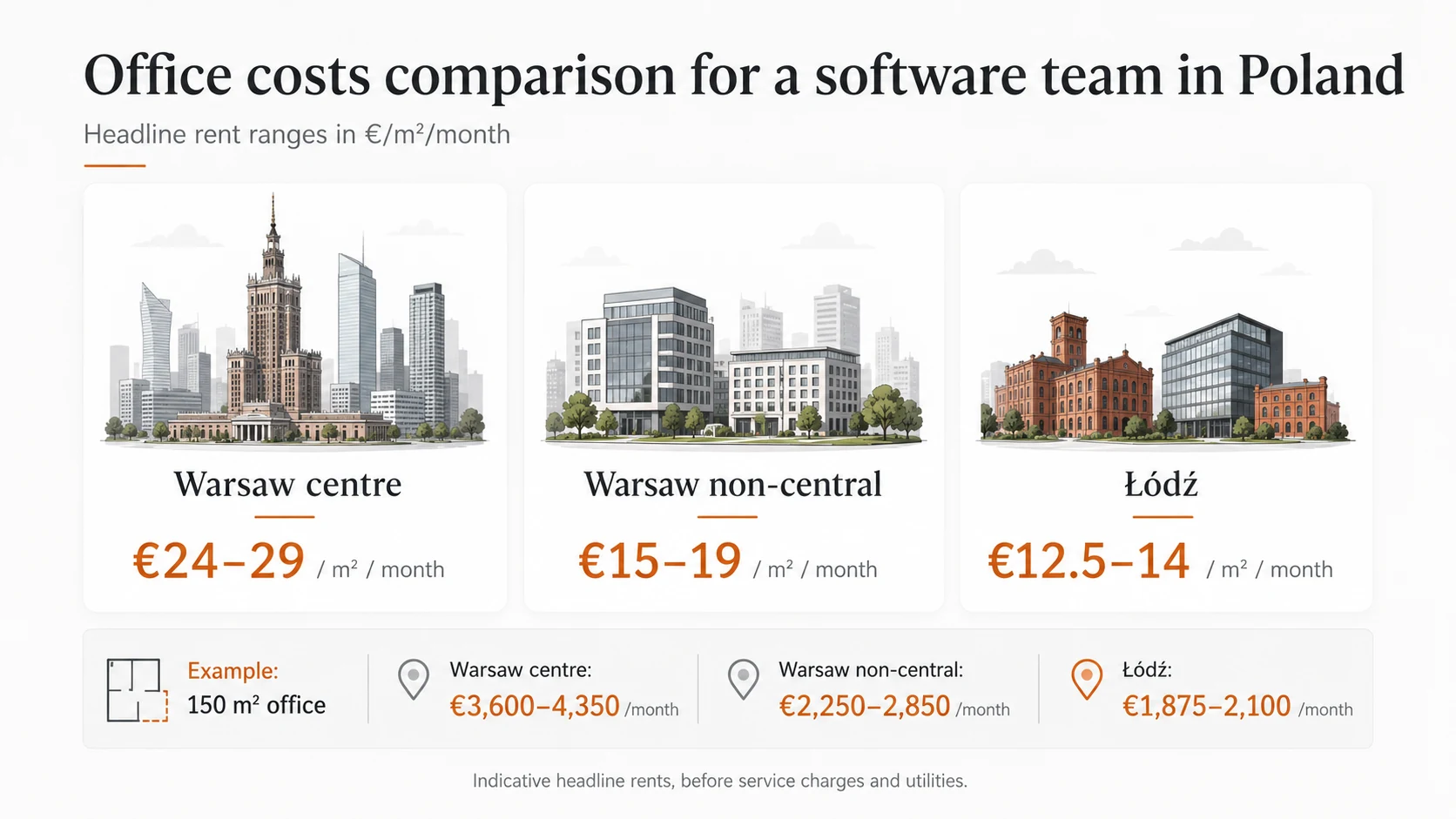
Take a 150 m² office for a fifteen person team. At Q2 2026 headline rents that is about €1,875 to €2,100 a month in Łódź, €2,250 to €2,850 in Warsaw outside the centre, and €3,600 to €4,350 in the Warsaw centre, before service charges and utilities.
Over a three year term the gap between Łódź and a central Warsaw address comes to roughly €60,000 to €80,000. That is more than a year of a mid-level engineer at full employer cost. That’s the trade you’re actually making, and it’s worth making it on purpose instead of defaulting to the capital.
Availability points the same way, though not only at Łódź. Warsaw vacancy was 8.5% in Q2 2026 against 19.8% in Łódź, so there is more to choose from outside the capital. Kraków at 19.0%, Wrocław at 21.8% and Katowice at 22.2% are in the same position. Łódź is simply the cheapest of the big regional markets.
What we recommend, by stage
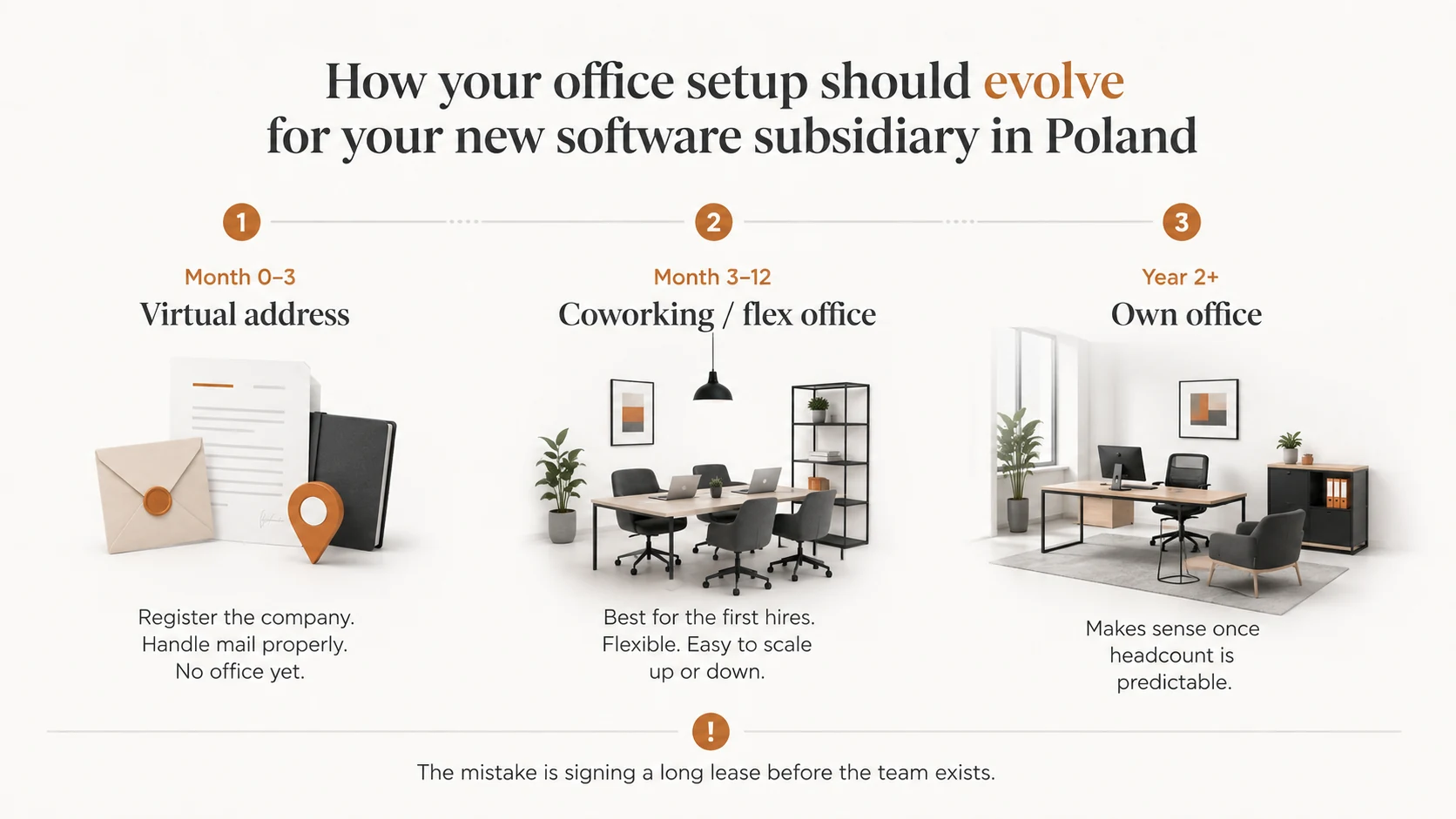
Month 0 to 3: a virtual address
Nobody is on payroll yet, so an office would be an empty room with a lease attached. A registered address with proper mail handling is the entire requirement at this point. Set up the e-Delivery address at the same time and decide who checks it. The company formation itself, with the fees and the timeline, is a separate job and we covered it in our guide to setting up an IT subsidiary in Poland. Interviews happen over video, or in a coworking meeting room booked by the hour.
Month 3 to 12: coworking
Most first teams live here, and for longer than people expect. Dedicated desks for whoever wants one, a meeting room for the weekly, and a contract you can walk away from. At five people, coworking costs a fraction of the office you would have to lease to hold them, and you learn how many desks the team actually uses before committing to anything.
There’s no headcount at which coworking stops working. In the teams we’ve run, the move usually came at around ten people, and it was almost never the cost per desk that forced it. It was privacy, meeting rooms and noise. Eight engineers arguing about an integration in a shared open space is a problem for everyone else on that floor.
Year two: your own space, if the numbers hold
A dedicated office earns its cost when headcount is steady, the team wants somewhere that belongs to them, and you have a reason to bring clients through the door. When you get there, buy quality instead of metres. A smaller office near a tram or metro line with a decent meeting room does more for a hybrid team than another fifty square metres nobody sits in.
Negotiate a break option or a shorter first term. Polish landlords will discuss both, particularly outside the central buildings. Candidates do notice the office, but they notice the commute and the hybrid policy first.
Remote, hybrid or in the office
Hybrid is the norm across Polish business generally. Polish IT is a different market, and this is the thing foreign employers most often get backwards. In the 2025 Badanie Społeczności IT survey, 59.9% of Polish IT respondents worked fully remotely, a further 19.2% were remote three or four days a week, and only 8.6% were in an office five days a week. The fully remote share has been falling since 2022, when it stood at 84%, but it is still the majority.
So a five day office requirement isn’t a firm preference here. It takes you out of consideration for most of the pool, unless the work genuinely needs hardware, a secure environment or a client site.
For us, roughly half the week in the office without fixed days has worked better than a fixed schedule. People pick when they come in. Attendance is only mandatory for the things that genuinely need a room, which for us means shared planning, whole team sessions and anything with a client.
The harder case isn’t the policy. It’s a brand new team. A senior engineer who’s worked remotely for five years will be fine anywhere. Someone learning your systems, your company and their colleagues at the same time asks dozens of small questions, and those get answered faster next to a person than in a ticket. A structured handover shortens that, and we wrote separately about how we run one.
There’s a legal detail here that surprises foreign employers. Remote work has been regulated in the Polish Labour Code since 2023, and the employer has to cover the cost of the electricity and the internet connection used for work. The law sets no amount and no formula, only that the allowance should reflect expected costs. In the companies we run it typically lands between PLN 50 and PLN 100 per person per month. It is not treated as employee income under the personal income tax act, so in practice neither PIT nor social contributions are due on it, and it belongs in the payroll, not in an informal side arrangement.
What usually goes wrong
The lease is signed before the team exists. Someone budgets an office for twenty, hires nine, and pays for eleven empty desks for four years. There’s no clever way out of it once the signature is on the page, and the break clause nobody bothered to negotiate turns out to be the one you needed.
The registered address is treated as an afterthought. Nobody owns the physical post, nobody checks the e-Delivery inbox, and everybody assumes somebody else does. A letter from the tax office starts a deadline whether or not anyone has read it.
Nobody checks whether registration is allowed at the address. Plenty of coworking contracts and most residential landlords do not permit it. Get it in writing before the notary appointment.
Nobody decides what actually requires the room. This is the hybrid failure we see most often. Either people commute in to sit on video calls, or the one session that needed everyone in the room happens with half the team at home.
Frequently asked questions
Can a company be registered at a virtual address in Poland?
Yes. It’s legal and ordinary. The contract has to state that you may use the address as the company seat, and you want the post handled rather than stored.
Can we start with a virtual address and move later?
Yes, and it’s what we normally do. Changing the address means a KRS filing. Moving the seat to a different town also means amending the articles at a notary, so it is worth choosing the city deliberately even if the office comes later.
Is Warsaw worth the extra office cost compared with Łódź?
On rent alone, no: €24 to €29 per m² in the Warsaw centre against €12.50 to €14 in Łódź. Warsaw earns it when your clients are there, when you are hiring at a seniority where the deepest pool matters, or when the team is already there. For a first engineering team the money usually does more as salary.
When does coworking become more expensive than a normal office?
Later than people expect on cost alone, because a lease brings service charges, fit-out and furniture with it. In practice the move gets triggered by privacy, meeting rooms and noise long before the invoice does, and in our teams that came at around ten people.
How much office space per person should we budget?
We plan 8 to 10 m² per person including meeting rooms and a kitchen, against a usual planning band of 8 to 12 m² for a conventional office. The right number depends heavily on desk sharing. The legal minimum of 2 m² of free floor area and 13 m³ of volume per person is a health and safety floor, not a planning figure.
Does the registered address have to be in the city where the team works?
No. It’s a town, and it does not have to be where anybody sits.
Do we owe people anything extra for working from home?
Yes. The Labour Code requires the employer to cover electricity and telecommunications costs for remote work, in practice through a fixed monthly allowance agreed up front. The law does not set the amount. It is exempt from income tax and social contributions.
If the office question is the one holding you up
This is a decision we make with clients as part of setting up the company: we sort out the registered address, compare the cities against where you actually want to hire, and handle the coworking contract or lease when the time comes. We are in Łódź ourselves, and we hire in Warsaw and the other main markets when that is where the people are.
Tell us what you are planning and we will tell you which of these options we would pick in your case.