The decision to set up an R&D center in Poland usually starts with the same few problems. The team at home is full and local hiring has slowed down. Meanwhile, the outsourcing contract that was meant to be temporary has been running for three years, and the vendor now knows parts of your product better than you do. Sooner or later someone in a management meeting asks why those engineers don’t simply work for you.
That is what an R&D center is: your own engineering team, employed by your own company, in a country where you can actually hire. This guide covers what it takes to build one here. We look at the tax reliefs that make the numbers work, what it costs to run, where to base it, how the first year usually goes, and when you should not do it at all.
R&D center, outsourcing or staff augmentation?
People use these terms loosely, so here is how we separate them:
| Outsourcing | Staff augmentation | R&D center | |
|---|---|---|---|
| Who employs the engineers | The vendor | The vendor | You |
| Who owns the code | On paper yours, but it can be disputed | Yours | Yours, with no room for dispute |
| Who the engineers feel loyal to | The vendor | Nobody in particular | You |
| What happens when you end it | The knowledge leaves with them | Same | Nothing, they are your staff |
| Cost structure | Day rate with margin | Day rate with margin | Salary plus overhead |
| Time to first engineer | Days | Weeks | Two to three months |
In short, outsourcing is quicker to start, but it does not get much better over time. An R&D center in Poland needs a quarter to get going. After that it keeps improving, because people stay, they build up context, and nobody sends you an invoice for a handover.
That said, if you need four people for six months, skip this. Vendors are built for exactly that kind of work.
Why so many companies already have an R&D center in Poland
Business services and R&D have been part of the Polish economy for twenty years. According to the ABSL report on the sector:
- 488,700 people work in business service centers in Poland, 6.2% more than a year earlier
- There are 2,081 centers, run by 1,258 investors from 50 countries
- 84.3% of the centers are foreign-owned
- Of the 61 centers opened between January 2024 and March 2025, 42.6% were IT and 26.2% R&D
- The sector exported $42.3 billion of services in 2024, about 5.7% of Polish GDP
The obvious conclusion is that the talent pool is large. However, the more useful one is that the whole ecosystem around it already exists. There are accountants who close the books for foreign parent companies every month, and employment lawyers who have drafted the same contracts many times. Landlords are used to signing leases with companies that have no Polish credit history, and recruiters know what a Kotlin developer costs this quarter. As a result, you are not pioneering anything, and that is good news when all you want is a team that works.
Tax reliefs that change the numbers
Lower salaries are usually what gets a company interested in an R&D center in Poland. In our experience, though, the tax rules are what gets the plan past the CFO.
R&D relief (ulga B+R): 200% of engineering wages
Under the Polish ulga B+R, you deduct qualifying costs a second time, on top of the normal deduction. For most eligible costs the extra deduction is 100%. For salaries and social contributions of employees working on R&D it is 200%, as the Ministry of Finance explains.
This matters a lot for a software company, because payroll is by far the biggest cost. In practice, the part of payroll that goes into R&D work is deducted three times: once as a normal cost and twice more under the relief. You can use it from the first year.
There are two catches. First, the work has to be creative and systematic, aimed at new or improved products or processes, and you need records showing who worked on which project and for how long. Set up that time tracking on day one, because rebuilding it eighteen months later is slow and painful. Second, the 200% applies to employees. Invoices from B2B contractors do not qualify, which is one more reason to think about the contract mix before you start hiring.
IP Box: 5% instead of 19%
Income from qualifying intellectual property is taxed at 5% instead of the standard 19% CIT. Copyright to a computer program is on the list of qualifying rights, so for software companies this is usually the relevant one.
The conditions matter. The IP has to come out of your own R&D work, and you need separate accounting records of revenue and costs for each IP asset. In addition, the nexus formula reduces the relief if much of the development was bought in rather than done in-house. IP Box is settled once a year, and in many cases it can be combined with the R&D relief. Your accountant should model both before you decide how to structure intercompany agreements.
Polish Investment Zone: worth asking about
The Polish Investment Zone offers a CIT exemption for 10 to 15 years in return for a qualifying investment. Entry thresholds for modern business services and R&D projects are lower than for manufacturing. Whether you qualify depends on headcount, spend and location, so it has to be checked case by case. Do that before you sign an office lease, because the location affects eligibility.
What an R&D center in Poland costs to run
Here are median figures from Polish job ads, converted at about PLN 4.32 to the euro:
| Level | Employment contract, gross (PLN) | Total employer cost (PLN) | B2B, net invoice (PLN) |
|---|---|---|---|
| Junior | 8,000 (~€1,850) | 9,640 (~€2,230) | 9,020 (~€2,090) |
| Mid | 15,000 (~€3,470) | 18,070 (~€4,180) | 18,900 (~€4,380) |
| Senior | 21,600 (~€5,000) | 26,000 (~€6,020) | 24,780 (~€5,740) |
For people on employment contracts, employer social contributions add about 20.5% to the gross salary. A quick rule of thumb is gross × 1.2048, plus 1.5% if the employee stays in the PPK pension scheme.
Beyond payroll, you need a budget for accounting and payroll services, equipment, software licenses and recruitment. If you want people in the same room, add office or coworking space. For a team of ten, these overheads usually come to 15–25% of payroll in the first year and drop after that.
So a senior engineer at roughly €6,000 a month all-in typically costs 40–60% less than a similar hire in Western Europe or the US. Unlike cheaper markets further away, you also stay inside EU employment law and GDPR, and your working day overlaps with the rest of Europe.
Choosing the legal form
Most foreign companies set up their R&D center in Poland as a limited company (sp. z o.o.), owned by the parent. It is a separate legal entity, so liability stays in Poland, local banks and landlords know the form well, and it can use all the reliefs described above. A branch of the foreign company is also possible, but it tends to create more paperwork on the parent’s side. We describe the steps in our guide to setting up an IT subsidiary in Poland.
Where to base it
For an R&D center in Poland, the default answer is Warsaw or Kraków, but it is not always the right one.
Kraków is the largest hub, with 108,000 people in 312 centers. It has the deepest talent pool in the country and also the strongest competition for it. Warsaw has the highest salaries, often around a third above comparable roles in smaller cities. Wrocław and the Tricity (Gdańsk, Gdynia, Sopot) sit somewhere in between.
We are based in Łódź, so we are not neutral here. The city has around 30,000 people in business services and ICT, its universities produce several thousand ICT graduates a year, and Warsaw is 90 minutes away by train. Salaries and office rents are noticeably lower. On the other hand, there is a downside you should know about: Warsaw employers actively recruit mid-level engineers from Łódź, and many graduates move to the capital in their first years of work.
A smaller city therefore gives you a real cost advantage and a real retention risk. The risk is manageable, but only if someone actively manages it. If the plan is to hire ten people in Łódź and check in once a quarter from abroad, you will lose your best engineers to Warsaw. What works instead is having someone on site who notices early when a key person starts taking long phone calls at lunchtime.
Your first hire: an engineering lead
The first person you hire for an R&D center in Poland shapes everyone who comes after. A strong senior developer is not enough here. What you need is an engineering lead who has built teams before: someone who has hired engineers in the Polish market, set up delivery processes and worked with a head office in another country. That person runs the interviews, sets the working culture and becomes the link between the two sites. Hiring five developers first and adding a lead later is the most common way to end up with a team that works hard but does not own anything.

Finding that person can take as long as hiring the rest of the team. For that reason, we often take on this role ourselves in the first phase. Between us, we have built and led engineering teams at Ericpol, Fujitsu and Ericsson, and since 2019 we have been running the Łódź site of a Swedish company, working closely with its head office in Sweden. We lead hiring and delivery until the team is in place, and then help you find a permanent lead and hand over to them. You can read more about us and our background.
If the right person is outside the EU, it can still work, but the permit adds time. See our notes on hiring engineers from outside the EU.
The first year of an R&D center, step by step
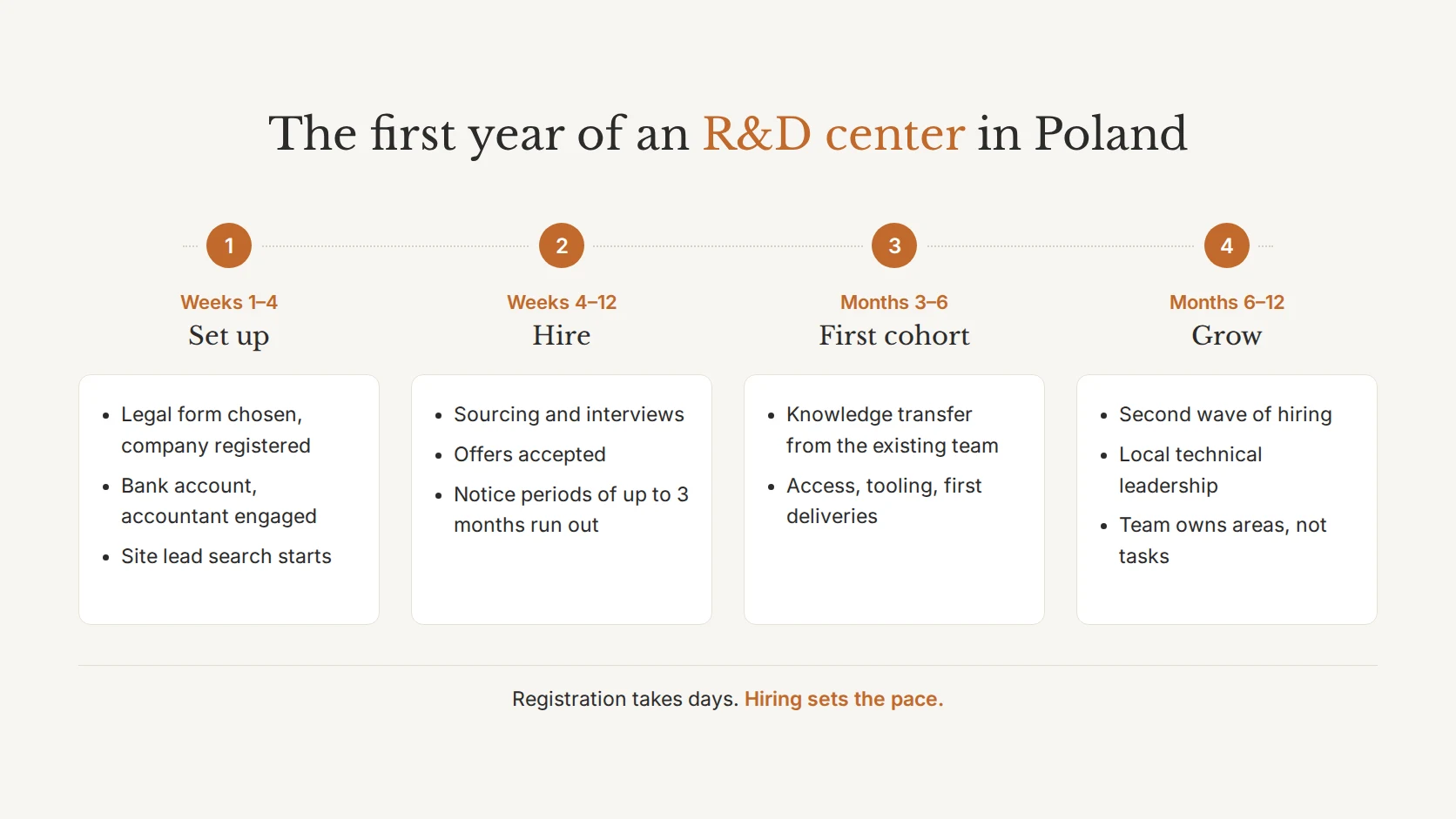
| Period | What happens |
|---|---|
| Weeks 1–4 | Legal form chosen and company registered, bank account opened, accountant engaged, first roles defined and the search for an engineering lead started |
| Weeks 4–12 | Sourcing and interviews. Polish notice periods can be up to three months, so someone who accepts an offer in week 6 may only start in week 14 |
| Months 3–6 | First group of engineers at work. Knowledge transfer from the existing team, access and tooling, first deliveries |
| Months 6–12 | Second wave of hiring, local technical leadership grows, and the team starts owning parts of the product instead of single tasks |
Registration is the quick part: a Polish limited company can be registered online in a few days. Hiring is what sets the pace. The most common reason plans slip is that nobody accounted for notice periods until the offers went out.
Around month six, most of these projects succeed or fail, and paperwork has nothing to do with it. What matters is whether the knowledge actually moved. That is why we treat knowledge transfer as a project in its own right, with phases, named owners and dates. Otherwise the documentation turns out to be a year out of date and delivery stalls for a quarter.
When an R&D center is the wrong choice
In a few situations we advise against opening an R&D center in Poland:
You need fewer than five people. The fixed cost of running a company, including accounting, payroll, compliance and management time, will not pay off. Instead, use an Employer of Record or a vendor until the headcount justifies your own entity.
The work is short-term. A twelve-month project does not need its own company.
Nobody at head office owns it. Without a senior sponsor, an R&D center turns into an outsourced team with worse economics. Someone needs to care about it at the level where budgets are decided.
You are trying to escape a delivery problem. If delivery is broken at home, it will also be broken in Poland, only with more distance in between.
Frequently asked questions
What is the minimum size for an R&D center in Poland?
Five to eight engineers plus a technical lead is roughly where the economics start to work. Below that, the fixed costs of running a company take up too large a share.
Do we own the intellectual property?
Yes. The engineers work for your company, so the IP belongs to your company. This is the main structural difference from outsourcing, where ownership depends on the wording of a contract.
Employment contracts or B2B?
Both are common in Polish IT. Employment contracts come with employer social contributions and statutory protections, and they qualify for the 200% R&D relief. With B2B, the engineer invoices you through their own business. However, it has to be a real contractor relationship. If it looks like employment in everything but name, the tax authority can reclassify it retrospectively.
Can we start small and grow?
Yes, that is the usual path. Most teams we build start with five to ten people and grow to twenty or thirty within two years, provided the first group works out.
Do we need an office?
Not legally. In practice, though, a hybrid setup builds a team faster than a fully remote one, especially in the first year, when people do not know each other yet.
How is this different from hiring a software house?
A software house sells you capacity, while an R&D center gives you your own organization. The first is a cost line; the second is an asset you own.
Want help setting it up?
BranchWise builds and runs R&D centers in Poland for companies based abroad. We handle company registration, recruitment, payroll and accounting, and the day-to-day management of the team once it is in place. You own the company and employ the people. We take care of the parts that are hard to run from another country.
Tell us what you are planning and we will walk you through how it would work in your case. You can also read more about how working with BranchWise works.
Sector figures: ABSL, Business Services Sector in Poland 2025. Salary figures: medians from Polish job ads, 2025–2026. Tax rules as of September 2026; this is not a substitute for advice from your accountant.